
I Drove 900 Miles to See the Gorilla I Hadn’t Seen in 30 Years—But the Keeper Locked the Gate and Said, “Even If We Clear You, She Doesn’t Owe You a Reunion”
“Lock the gate. He cannot be allowed near her.”
I stopped with one hand against the steel entrance.
Beyond that gate was a gorilla I had not seen in thirty years.
I had driven almost nine hundred miles to get there.
And now, less than a hundred yards from her habitat, a keeper had just told me I might leave without ever seeing her.
My name is Samuel Grant.
I am seventy-two years old.
For six years of my younger life, I helped care for a western lowland gorilla named Mara at a wildlife center in North Carolina.
She was barely grown when I first met her.
I was thirty-six, convinced I understood animals because I had read the manuals and learned the procedures.
Mara spent the next six years teaching me how little that meant.
Then life changed.
My wife became ill.
I left animal care.
We moved to Ohio.
Eventually, Mara was transferred to Blue Ridge Primate Sanctuary outside Asheville.
My wife recovered, we raised two children, buried my parents, became grandparents, lost friends, changed homes.
And somehow thirty years disappeared.
But I never forgot Mara.
So when my daughter gave me the sanctuary trip for my seventy-second birthday, I pretended I wasn’t terrified.
What if Mara was too old?
What if she was ill?
What if she had died before I arrived?
Worst of all:
What if she looked straight at me and there was absolutely nothing behind her eyes?
I thought I had prepared myself for that.
I had not prepared myself for the locked gate.
The keeper standing in front of me was named Rachel Torres.
Her voice wasn’t rude.
That almost made it harder.
“I know you have an appointment, Mr. Grant.”
“Then what happened?”
“Our veterinary team received a health alert from another wildlife facility you visited two days ago.”
I stared at her.
My daughter and I had stopped at a rehabilitation center in Kentucky during the drive.
An old colleague had shown me their staff preparation area and a service corridor.
“I didn’t touch any animals.”
“I understand.”
“Then why can’t I see Mara?”
Another woman approached.
Dr. Naomi Keller, the sanctuary veterinarian.
“An ape at that facility developed respiratory symptoms yesterday. They’re identifying recent staff and visitors who may have entered relevant areas.”
“I feel fine.”
Naomi nodded.
“That helps. It doesn’t answer everything.”
Then Rachel said the sentence I would remember long after everything else.
“And even if medical clears you, Mara doesn’t owe you a reunion.”
I turned toward her.
“I never said she did.”
“You came a long way.”
“Yes.”
“People come a long way and start believing that means the animal should perform the ending they imagined.”
My face became hot.
“I came to see her. I didn’t come to collect something from her.”
Rachel held my gaze.
Then nodded once.
“Good.”
They took me inside the administrative building.
Naomi started verifying exactly where I had been during the Kentucky visit.
While she made calls, another keeper named Laura offered me a live security feed from Mara’s habitat.
I walked toward the monitor.
And stopped.
There she was.
Older.
Much older.
Silver scattered through her coat.
Her shoulders had changed.
Her movements were slower.
But when she picked up a branch, rotated it in one hand and stripped the leaves before dropping the empty stem across her knee—
I laughed.
“She always did that.”
Laura smiled.
Mara selected another branch.
“Hello, old girl,” I whispered.
Laura touched the desk gently.
“There’s no speaker.”
I nodded.
Of course there wasn’t.
Mara could not hear me.
I sat down.
After thirty years, I was watching her on a twelve-inch monitor from another room.
Then things became worse.
Rachel entered carrying the special-viewing plan.
“I’m recommending we postpone even if the health issue is cleared.”
“Why?”
She explained that a previous private group had crowded the viewing glass.
They kept calling Mara toward them.
She repeatedly moved away.
The visitors kept trying.
Staff eventually ended the session.
Then maintenance work began near the same observation area.
Since then, Mara had been spending less time there.
“So I can pass every medical check,” I said slowly, “and still not see her?”
“Yes.”
No comforting language.
No apology.
Just yes.
My train home left Saturday afternoon.
Another nine-hundred-mile journey would not be easy.
I had prepared for Mara not remembering me.
Now I faced the possibility of never finding out.
Rachel slid the viewing rules toward me.
One visitor.
Closed glass barrier.
No food.
No personal objects.
No calling repeatedly.
Mara free to stay anywhere she wanted.
Then Rachel pointed at the final line.
“If she walks away after ten seconds?”
“Then she walks away.”
“People say that before they get here.”
I looked directly at her.
“I am here for a moment, Rachel. Not a performance.”
She studied me for several seconds.
Then Naomi returned.
The health review wasn’t complete.
The visit remained suspended.
That night, alone in my hotel room, I opened the photograph I had carried across three states.
Young Mara sat behind a training barrier.
Thirty-six-year-old me stood outside it, one hand raised.
I suddenly remembered something I hadn’t thought about in decades.
One morning, Mara had refused to approach that station.
I called again.
Then again.
I became frustrated because I was late.
My supervisor finally asked:
“If this is voluntary, Samuel, why do you keep demanding the answer you want?”
I had lowered my hand.
The shame of that moment had made me a better keeper.
Now I wondered if thirty years later I was making the same mistake in a different form.
The next morning, Naomi called.
The Kentucky center had confirmed I never entered the isolation building and had not handled equipment connected to the sick animal.
Medical risk had been narrowed enough that a carefully controlled visit could be approved.
I nearly shouted with relief.
Then Naomi added:
“The animal-care team still has to approve Mara’s side.”
I drove to the sanctuary.
Rachel met me.
“Mara still hasn’t returned to her usual routine around the viewing space.”
My train left the next day.
For several seconds, every selfish part of me wanted to say:
I’m seventy-two.
I drove nine hundred miles.
I waited three decades.
Please.
Instead I heard my old supervisor’s voice.
If this is voluntary, why do you keep demanding the answer you want?
I looked at Rachel.
“If the answer is no, don’t change it for me.”
For the first time, her expression softened.
I went back to the hotel.
Packed my photograph.
Set my alarm.
And accepted that I might go home without seeing Mara at all.
Then, at 6:12 the next morning, my phone rang.
It was Rachel.
“Mr. Grant?”
I sat upright.
“Mara used the observation area normally this morning.”
I couldn’t speak.
“We can offer you fifteen minutes before you leave.”
Then she paused.
“But understand this clearly.”
“I do.”
“No promise she comes near you.”
“I know.”
“No promise she remembers.”
“I know.”
“And if she chooses to leave—”
“Then I let her go.”
I arrived before sunrise had fully cleared the mountains.
My hands shook while I signed the health declaration.
Naomi walked me through hygiene precautions.
Fresh protective clothing.
Sanitized shoes.
Nothing from my hotel room allowed inside.
My faded green baseball cap—the one I had worn during my years working with Mara—stayed in my bag.
Thirty years earlier, I would have wanted to bring it in.
A familiar object.
A scent.
Something to “help her remember.”
Now I understood that would make the moment less honest.
If Mara approached, it needed to be because she chose to.
Rachel met me outside the viewing room.
No hostility this time.
But no sentimentality either.
“If she moves away, we stop.”
“I understand.”
She opened the door.
The room was small.
One chair.
A reinforced glass wall.
Beyond it stretched Mara’s habitat—grass, logs, climbing structures, rock, trees and several places completely hidden from view.
That was important.
She could disappear whenever she wanted.
Mara sat perhaps forty yards away sorting leaves.
I lowered myself into the chair.
For weeks before the trip, I had imagined what I would say.
Her name.
A phrase I used when she was young.
Maybe something ridiculous like:
“Do you remember me?”
Now I said nothing.
Five minutes passed.
Mara looked toward the glass once.
My heart jumped.
Then she went back to the branch in her hands.
Rachel stood quietly near the door.
I could feel her watching me.
Not suspiciously.
Protectively.
For Mara.
Six minutes.
Seven.
I began to understand that this might be the reunion.
Me sitting behind glass.
Mara eating leaves forty yards away.
And perhaps that was enough.
“Samuel,” Rachel said quietly, “she may stay there.”
“I know.”
My fingers were trembling against my knee.
There was one old gesture I wanted to try.
Not a command.
Not even a formal cue anymore.
Just something Mara had seen thousands of times when she was young.
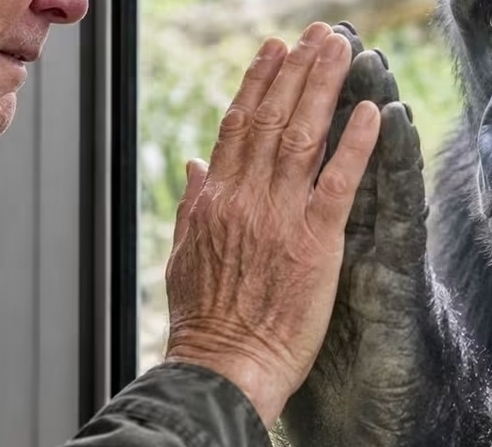
I slowly lifted my right hand.
Open palm.
Then waited.
No tapping.
No calling.
No waving.
Mara stopped chewing.
Her head lifted.
My chest tightened so sharply it hurt.
She looked toward me.
Then stood.
She walked several steps closer.
Stopped.
I almost laughed.
Almost cried.
Then she turned her head toward the back of the habitat.
The trees were behind her.
One step and she could disappear.
I lowered my hand immediately.
That mattered.
I would not call again.
Would not bargain.
Would not turn her choice into a test.
Mara stood between the glass and the trees.
I looked toward Rachel.
“I think she’s finished.”
Then Rachel’s eyes shifted past me.
I turned back.
Mara was walking toward the window.
Slowly.
No running.
No dramatic chest beating.
No movie soundtrack.
Just an old gorilla crossing a patch of morning grass.
She stopped a few feet from the glass.
Sat sideways rather than directly in front of me.
For several seconds she looked toward the ground.
Then at me.
My eyes filled.
“Hello, Mara.”
She blinked.
That was all.
No magical gesture.
No proof.
No way to climb inside her mind and read a thirty-year memory.
But she stayed.
I placed both hands in my lap.
The photograph in my bag suddenly didn’t matter.
I had spent months wondering whether she would recognize my face.
My voice.
The open palm.
Now that she was there, the question began to feel smaller.
Mara looked older than she had on camera.
The skin around her eyes was different.
Her shoulders sagged more.
One finger looked slightly stiff.
Thirty years had happened to her too.
That thought almost broke me.
I had spent the trip remembering the young gorilla.
But she had not been frozen in my memory waiting for me.
She had lived.
New keepers.
New companions.
Illnesses.
Seasons.
Losses.
Thousands of mornings I knew nothing about.
I was not returning to reclaim part of her life.
I was visiting the life she had built without me.
Mara remained near the glass for perhaps six minutes.
At one point she picked up a small twig.
Turned it.
Stripped two leaves.
Dropped the empty stem beside her knee.
I laughed through my tears.
Rachel looked away, giving me the privacy of pretending she hadn’t noticed.
Then Mara stood.
My first instinct was immediate.
Say her name.
Keep her there one more second.
I didn’t.
She walked toward the trees.
Stopped once.
Not to look back at me.
Just to pick something from the grass.
Then disappeared behind the vegetation.
I remained seated.
Rachel checked the clock.
“You still have five minutes.”
I stood.
“She’s finished.”
Something changed in Rachel’s face.
Not relief exactly.
Maybe trust.
At the exit she handed me my bag.
“I was wrong about you.”
“About what?”
“What you wanted from this.”
I shook my head.
“No. You were right about what she needed.”
Rachel looked at me for a moment.
Then extended her hand.
I took it.
Outside, I called my daughter.
She answered immediately.
“Dad?”
“Yeah.”
“Did you see her?”
I couldn’t speak for a few seconds.
“Yes.”
“Oh, Dad.”
I sat on a bench near the parking lot.
Then she asked the question everyone would eventually ask.
“Did she remember you?”
I stared toward the gorilla building.
“I can’t tell you that.”
“What do you mean?”
“She came over.”
“That sounds like yes.”
“No.”
My voice broke.
“It means she came over.”
There was a long silence.
Then my daughter said:
“Was that enough?”
I closed my eyes.
“Yes.”
It was.
On the train home, I kept thinking about all the endings I had imagined.
Mara recognizing me instantly.
Running toward the glass.
Touching her palm against mine.
Making some old sound I remembered.
Those versions would have been beautiful.
They also would have belonged mostly to me.
The real moment was quieter.
She was offered a choice.
At first she stayed away.
Then she came closer.
Then she left.
And every part of that mattered equally.
Years earlier, I had taught visitors that great apes were not entertainers.
I had explained that approaching a viewing window was not consent to interaction.
I had told young keepers never to punish an animal for walking away from voluntary training.
Yet somewhere inside myself, I had still carried a fantasy that thirty years of memory entitled me to one last moment.
Rachel had challenged that fantasy before I ever entered the room.
At first I resented her.
Now I was grateful.
Without her, I might have ruined the very thing I had come to experience.
A voluntary approach means nothing if the animal is not equally free to refuse it.
A year after the visit, Rachel emailed me.
Mara was doing well.
Slower.
Sleeping more.
Still stripping branches the same infuriating way and leaving the stems everywhere.
I wrote back:
Some things never improve.
Rachel answered:
We’ve stopped trying.
That made me laugh.
We exchanged occasional emails after that.
Nothing dramatic.
Health updates.
A photograph once or twice.
I never asked whether Mara had “searched for me.”
Never asked whether she returned to the window afterward.
Those questions belonged to the old version of me.
The man who wanted behavior to validate the story he hoped was true.
Three years later, I received another email.
This one came from Laura.
Mara had declined rapidly after several age-related medical problems.
The veterinary team had been managing her comfort.
That morning, she died peacefully with familiar members of her care team nearby.
I read the email at my kitchen table.
Then walked outside.
My daughter found me sitting on the porch an hour later.
“You okay?”
“No.”
She sat beside me.
After a while she asked:
“Are you glad you went?”
“Yes.”
“Even with all the waiting?”
“Especially because of the waiting.”
She looked confused.
So I explained.
The locked gate.
The health alert.
Rachel’s refusal.
My anger.
The old photograph.
The memory of my supervisor asking why I called something voluntary while refusing to accept “no.”
Then the final morning.
Mara staying away.
My open palm.
Her hesitation.
Her approach.
Her departure.
My daughter wiped her eyes.
“You think she remembered.”
It wasn’t a question.
I watched the trees in my backyard move in the wind.
“I think I spent most of my life believing memory was the most important part.”
“And now?”
“Now I think choice was.”
Mara did not owe me proof.
She did not owe me recognition.
She certainly did not owe me affection because thirty years earlier I had helped care for her.
Whatever existed inside her memory belonged to her.
What she gave me was something smaller and, somehow, more meaningful.
A few minutes.
Freely chosen.
That was enough.
I still have the old photograph.
Young me beside the training station.
Young Mara behind the barrier.
My palm raised.
For decades, I thought the picture represented our relationship.
Now I see something else.
A man offering an invitation.
An animal deciding whether to accept.
That difference is everything.
People hear stories about reunions between humans and animals and usually focus on recognition.
Does the lion remember?
Does the elephant remember?
Does the gorilla remember?
I understand why.
We want to matter.
We want proof that love leaves permanent marks.
Maybe it does.
But I learned something more difficult from Mara.
Caring for another living creature is not about guaranteeing that you remain important to them.
It is about respecting what matters to them even when it costs you the ending you wanted.
The sanctuary could have ignored the health alert because I had traveled so far.
They didn’t.
They could have pushed Mara toward the viewing area because I was old and had waited thirty years.
They didn’t.
Rachel could have treated my nostalgia as more important than Mara’s comfort.
She didn’t.
And in the end, because everyone was willing to let the reunion fail—
the moment that happened was real.
I was seventy-two years old when I finally sat across from the gorilla who had shaped the beginning of my career.
I wanted to know whether thirty years had erased me.
Mara never answered that question.
She gave me a better one.
Could I still care about her if she chose to walk away?
When she disappeared into the trees, I already knew the answer.
Yes.
And that was when I finally understood what the word voluntary had been trying to teach me all those years.