
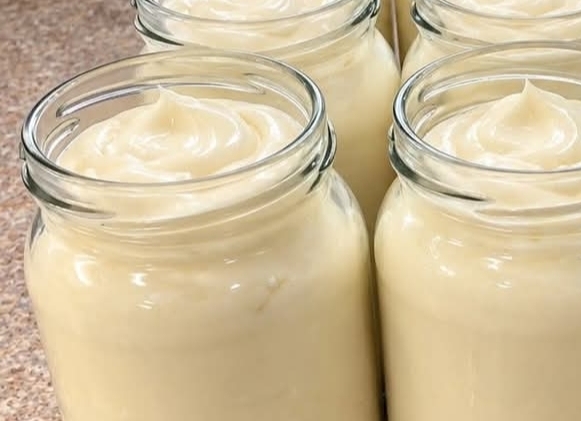
- Prep Time: 10 minutes
- Emulsification/Active Blending Time: 3 minutes
- Resting/Chilling Time: 30 minutes
- Total Time: 43 minutes
- Yield: Approximately 1½ cups (24 tablespoons)
- Skill Level / Intensity: Moderate
- Intensity Note: Mayonnaise is an emulsion—a delicate suspension of fat in water. The physical intensity is low if using a stick blender or food processor, but the procedural precision is high. Pouring oil too quickly will break the emulsion into a greasy liquid.
Equipment Needed
- Immersion blender (stick blender) and a wide-mouth mason jar, OR a standard food processor fitted with the small-batch emulsion cup.
- Measuring spoons and liquid measuring cup.
- Silicone spatula.
- Airtight glass jar for storage.
Ingredients
The Base Emulsifiers
- 1 large egg yolk + 1 whole egg (pasteurized, brought completely to room temperature)
- 1 tablespoon cold water (crucial for hydration and volume)
The Flavor Foundation
- 1½ tablespoons distilled white vinegar (5% acidity)
- 1 teaspoon fresh lemon juice (adds a touch of brightness)
- 1 teaspoon smooth Dijon mustard or prepared yellow mustard (prepared yellow matches the exact Heinz baseline profile best)
- ¾ teaspoon fine table salt
- 1 teaspoon granulated sugar
- ⅛ teaspoon onion powder (a key commercial flavor note)
The Fat Matrix
- 1 cup neutral oil (canola, light sunflower, or refined soybean oil; avoid cold-pressed olive or virgin avocado oils, as they create a bitter taste and green hue when whipped at high speed)
Step-by-Step Instructions
Step 1: Temperature & Preparation (Intensity: Low)
Ensure the eggs and liquids sit at room temperature for at least 30 minutes before starting. Emulsifiers (specifically lecithin in the yolk) bond far more effectively with fats when not chilled. Cold eggs are the leading cause of broken homemade mayonnaise.
Step 2: Combine the Base (Intensity: Low)
Add the whole egg, extra yolk, distilled white vinegar, lemon juice, mustard, salt, sugar, onion powder, and the tablespoon of cold water into the bottom of a wide-mouth pint mason jar (or the bowl of your food processor).
Let the ingredients settle for 30 seconds.
Step 3: Layer the Oil (Intensity: Low)
Gently pour the full cup of neutral oil directly on top of the egg mixture. Because the oil has a lower density than the water-and-egg mixture, it will float clearly on top in a separate layer. Allow the two layers to separate completely.
Step 4: The Immersion Blender Technique (Intensity: High Focus)
- Lower the head of the immersion blender all the way to the very bottom of the jar, placing it flat over the egg yolk base.
- Turn the immersion blender onto its highest speed setting. Do not move the blender for the first 15 to 20 seconds.
- As the blade spins, a thick, white, creamy emulsion will immediately form at the bottom of the container.
- Once the bottom third of the jar turns completely opaque and creamy, tilt the blender head slightly and pull it upward very slowly (over a span of 10–15 seconds) to draw the remaining surface oil downward into the vortex.
- Once all oil is incorporated, pulse up and down two or three times until completely homogeneous and stiff.
(If using a food processor: Process the egg and seasoning base for 20 seconds first, then with the motor running on medium-high, drip the oil in drop-by-drop through the top feed chute for the first 3 tablespoons, then slowly stream the rest in a pencil-thin trickle until fully incorporated.)
Step 5: Adjust & Chill (Intensity: Low)
Taste the mayonnaise on a clean spoon. If you prefer a sharper kick, whisk in an extra ¼ teaspoon of vinegar. Transfer the mayonnaise into an airtight jar and refrigerate for a minimum of 30 minutes before serving. Chilling allows the fats to solidify further, producing the authentic stiff spoonability of Heinz.
Troubleshooting Common Issues
- The Mayo Is Too Thin: Homemade mayo thickens as more oil is incorporated into the water phase. If your mayo seems loose, you either under-blended or need to slowly stream in another 2 to 3 tablespoons of neutral oil while blending.
- The Emulsion Broke (Oily Separation): Clean your blender cup. Add 1 fresh egg yolk and 1 teaspoon of warm water to the bottom of the clean jar. Turn the blender on and slowly drizzle the separated, broken mayonnaise mixture into the new yolk base. It will re-emulsify immediately.
- Bitterness: Bitter taste occurs when extra virgin olive oil is used with high-speed blades, which breaks down polyphenols. Always stick to pure, refined neutral oils like canola or sunflower.
Storage & Shelf Life
Because this recipe contains fresh eggs without commercial antimicrobial preservatives:
- Keep tightly sealed in a glass jar in the coldest part of your refrigerator (not the door).
- Store for up to 7 to 10 days.
- If pasteurized in-shell eggs are used, it will safely keep for up to 14 days.
Nutritional Information
Serving Size: 1 Tablespoon (approx. 14g)
Servings Per Batch: 24
| Metric | Amount Per Serving | % Daily Value* |
| Calories | 95 kcal | — |
| Total Fat | 10.5 g | 13% |
| Saturated Fat | 0.8 g | 4% |
| Trans Fat | 0.0 g | — |
| Polyunsaturated Fat | 3.1 g | — |
| Monounsaturated Fat | 6.2 g | — |
| Cholesterol | 12 mg | 4% |
| Sodium | 85 mg | 4% |
| Total Carbohydrate | 0.3 g | 0% |
| Dietary Fiber | 0.0 g | 0% |
| Total Sugars | 0.2 g | — |
| Protein | 0.2 g | 0% |
| Vitamin D | 0.1 mcg | 0% |
| Calcium | 2 mg | 0% |
| Iron | 0.1 mg | 0% |
| Potassium | 6 mg | 0% |