
| Prep Time | 45 minutes |
| Cook / Browning Time | 20 minutes |
| Processing Time (Pints) | 75 minutes |
| Processing Time (Quarts) | 90 minutes |
| Target Pressure | 10–11 lbs (Weighted Gauge) / 11 lbs (Dial Gauge) at sea level |
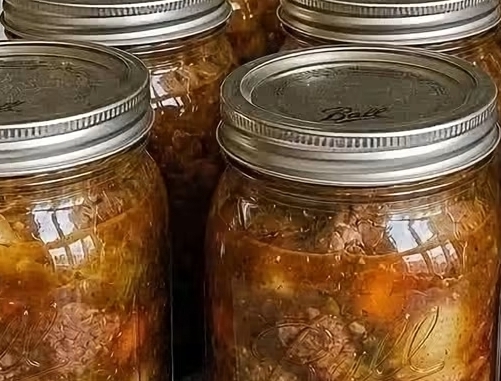
| Recipe Yield | Approx. 7–8 Quart Jars (or 14–16 Pint Jars) |
Recipe Intensity & Skill Levels
Understanding the intensity involved helps you plan your cooking day efficiently.
- Culinary Skill Level: Beginner to Intermediate — Requires basic knife skills, searing techniques, and strict adherence to canning safety procedures.
- Physical Intensity: Moderate — Involves continuous slicing, searing meat in batches, handling heavy boiling pots, and lifting a loaded pressure canner.
- Timing & Attention Intensity: High during processing — Pressure canning demands vigilant monitoring of pressure gauges throughout the full 75 to 90-minute cycle.
Ingredients List
Meat & Produce
- 5 lbs Beef stew meat (chuck roast or round roast cut into 1-inch cubes)
- 3 lbs Small yellow or red potatoes (washed, peeled, and cut into 1-inch cubes)
- 2 lbs Carrots (peeled and sliced into $\frac{1}{2}$-inch thick rounds)
- 1.5 lbs Yellow onions (chopped into medium pieces)
- 4 stalks Celery (sliced into $\frac{1}{2}$-inch pieces)
- 4 cloves Garlic (minced)
Liquids & Pantry Staples
- 8–10 cups Low-sodium beef stock or bone broth (kept hot)
- 2 tbsp Olive oil or vegetable oil (for searing)
- 2 tbsp Tomato paste
- 1 tbsp Worcestershire sauce
Seasonings & Spices
- 2 tbsp Salt (canning salt or kosher salt)
- 1 tbsp Black pepper (freshly ground)
- 2 tsp Dried thyme
- 2 tsp Dried rosemary
- 2 Dried bay leaves (for simmer, remove before canning)
(Note: Do not add flour, cornstarch, cream, or pasta to the jar before canning. Thickening agents interfere with heat penetration. You will thicken the stew upon reheating.)
Step-by-Step Instructions
Step 1: Prep the Canning Equipment
- Inspect your pressure canner, gasket, and vent pipe to ensure everything is clean and working correctly.
- Fill the pressure canner with 2 to 3 inches of water and place it on the stove over low heat to warm up.
- Wash your jars, lids, and bands in hot, soapy water. Keep the jars warm in hot water to prevent thermal shock when filling.
Step 2: Sear the Beef
- Heat olive oil in a large stockpot or Dutch oven over medium-high heat.
- Season the beef cubes lightly with salt and pepper.
- Working in small batches, sear the beef on all sides until nicely browned (about 2–3 minutes per batch). Transfer browned meat to a separate large bowl. Do not cook the meat all the way through—just brown the exterior.
Step 3: Build the Stew Base
- In the same pot, add the chopped onions and garlic. Sauté for 2–3 minutes until fragrant.
- Stir in the tomato paste and Worcestershire sauce, cooking for another minute.
- Pour in the hot beef broth, scraping up any browned bits stuck to the bottom of the pot.
- Stir in the dried thyme, dried rosemary, remaining salt, and black pepper. Bring to a simmer.
Step 4: Combine Vegetables and Meat
- Add the seared beef back into the pot along with the diced potatoes, carrots, and celery.
- Bring the mixture to a gentle boil for 5 minutes only. Cooking them briefly ensures everything is hot when packed into jars without overcooking the vegetables into mush during canning. Remove bay leaves.
Step 5: Jar Packing (Hot Pack Method)
- Using a jar funnel, ladle the hot meat, vegetables, and hot broth mixture into your warmed jars.
- Leave 1 inch of headspace at the top of each jar. Headspace is essential for a proper seal.
- Use a non-metallic bubble remover tool to slide around the inside edge of each jar, releasing trapped air bubbles. Adjust liquid level if necessary to maintain the 1-inch headspace.
- Wipe the rim of each jar with a clean paper towel dipped in warm water (or vinegar) to remove grease or food particles.
- Place a lid centered on top and screw the band on until finger-tip tight.
Step 6: Pressure Canning Process
- Place jars onto the rack inside the preheated pressure canner.
- Lock the canner lid into position, keeping the vent pipe open.
- Turn heat to medium-high and allow steam to escape freely from the vent pipe for 10 continuous minutes to exhaust air.
- Place the weighted gauge or close the petcock. Allow pressure to build to your target elevation pressure (10–11 lbs).
- Once target pressure is reached, adjust heat to maintain steady pressure and start your timer:
- Pints: Process for 75 minutes
- Quarts: Process for 90 minutes
- When timer ends, turn off heat. Let the canner cool and depressurize naturally. Do not force-cool the canner.
Step 7: Cooling & Storage
- Once pressure returns to zero, carefully remove the lid pointing away from your face.
- Using a jar lifter, transfer jars to a towel-lined counter, leaving 1–2 inches between jars.
- Let jars rest undisturbed for 12 to 24 hours. You will hear satisfying “pops” as seals form.
- Check seals, remove screw bands, wipe jars clean, label with the contents and date, and store in a cool, dark pantry.
How to Serve
When ready to eat, simply pour the contents of a jar into a saucepan. Bring to a simmer over medium heat.
- To Thicken: Mix 2 tablespoons of cornstarch or flour with 3 tablespoons of cold water to create a slurry. Stir the slurry into the simmering stew and cook for 2–3 minutes until thick and glossy.
- To Serve: Garnish with fresh parsley and serve alongside crusty sourdough bread or warm biscuits.
Shelf Life & Storage Expectations
Properly processed and sealed pressure-canned beef stew stores safely for 12 to 18 months in a cool, dark, dry environment. Once opened, keep refrigerated and consume within 3 to 4 days.
Nutritional Information
Below is the estimated nutritional content per serving (approx. 1 pint / 2 cups of stew, prepared without added starch thickeners).
| Nutrient | Amount Per Serving | % Daily Value* |
| Calories | 380 kcal | — |
| Total Fat | 12 g | 15% |
| Saturated Fat | 4.5 g | 22% |
| Trans Fat | 0 g | — |
| Cholesterol | 85 mg | 28% |
| Sodium | 620 mg | 27% |
| Total Carbohydrates | 28 g | 10% |
| Dietary Fiber | 4 g | 14% |
| Total Sugars | 5 g | — |
| Protein | 38 g | 76% |
| Vitamin D | 0.2 mcg | 1% |
| Calcium | 45 mg | 4% |
| Iron | 4.2 mg | 23% |
| Potassium | 890 mg | 19% |