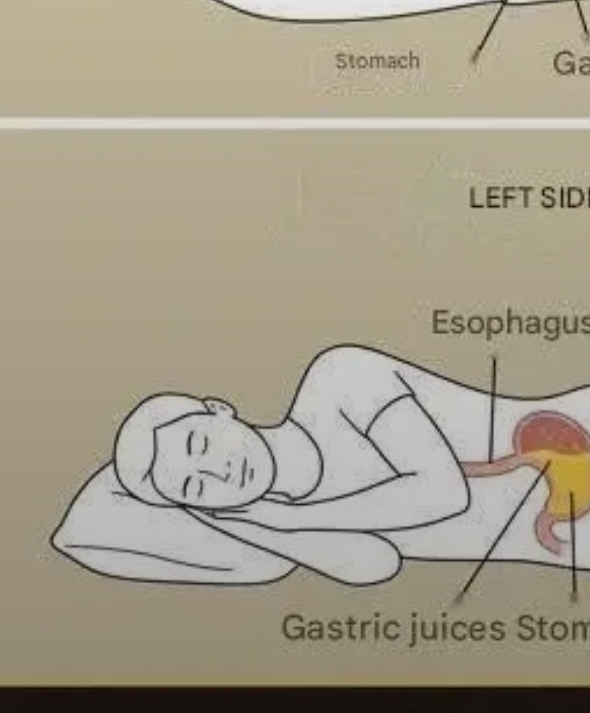
For many people, the hours spent asleep are a time of peaceful restoration. However, for millions of others, nighttime is accompanied by an unwelcome guest: heartburn. Waking up with a sour taste in your mouth, a burning sensation in your chest, or a chronic cough is a frustrating way to start the day. While dietary choices and stress play massive roles in triggering acid reflux, an often-overlooked factor is how you position your body during those eight hours of rest.The infographic above highlights a crucial anatomical reality that many people are unaware of: sleeping on your right side can actively encourage stomach acid to flow back up into your esophagus. The image contrasts the “RIGHT SIDE” and the “LEFT SIDE,” showing how gravity dictates the movement of gastric juices depending on your sleeping position. The warning is clear: “Be careful if you always sleep on your right side.”But why exactly does this happen? Is it a concern for everyone, or only those with pre-existing conditions? And what can you do to protect your digestive health while you sleep? Understanding the anatomy behind this phenomenon provides the answer and offers a simple, drug-free way to improve your nighttime comfort and overall well-being.The Anatomy of Reflux: Understanding the Stomach and EsophagusTo understand why your sleeping position matters so much, you must first understand the geometry of your digestive tract. The human stomach is not a perfectly symmetrical sphere; it is a J-shaped muscular organ located in the upper left quadrant of the abdomen.The esophagus (the food pipe) enters the stomach through a valve called the lower esophageal sphincter (LES). This sphincter is designed to be a one-way gate, opening to allow food to enter the stomach and closing tightly to prevent the highly acidic contents of the stomach (gastric juices) from splashing back up into the delicate, unprotected tissue of the esophagus.When you are standing or sitting upright, gravity is your ally. It helps keep the contents of the stomach at the bottom, and the natural anatomy of the stomach acts to pool the acid away from the opening of the esophagus. However, when you lie down flat, gravity is no longer pulling the acid downward. Instead, the fluids are free to shift and pool based on the angle of your body.The Angle of His: A Crucial DetailThere is a specific anatomical feature known as the “angle of His.” This is the sharp angle where the esophagus meets the stomach. When the stomach is full, this angle acts as a flap, helping to seal the LES and prevent reflux. But this protective mechanism is highly dependent on your posture.Why Sleeping on Your Right Side is ProblematicThe infographic accurately depicts the mechanical issue: when you sleep on your right side, the stomach is positioned higher than the esophagus. Because the stomach is J-shaped, lying on the right side causes the gastric juices to pool directly against the lower esophageal sphincter.Gravity Works Against YouThink of the stomach as a partially filled water balloon. If you lay the balloon on its right side, the water will pool toward the opening. Similarly, when you lie on your right side, the liquid content of your stomach rests against the LES. Since the LES naturally relaxes slightly during sleep, the pressure of the pooled acid can easily force its way up into the esophagus.The Consequences of Nighttime RefluxAcid reflux at night is more than just an inconvenience. It can lead to a host of uncomfortable symptoms and long-term complications:Disrupted Sleep: The burning pain and coughing associated with reflux frequently wake people up, leading to fatigue and daytime drowsiness.Morning Hoarseness: Stomach acid that reaches the throat can irritate the vocal cords, causing a raspy voice in the morning.Chronic Cough: Reflux can trigger a dry, persistent cough as the body tries to clear the acid from the airway.Damaged Enamel: Frequent exposure to stomach acid can erode the enamel on your teeth.Worsening Asthma: Inhaling tiny droplets of stomach acid can aggravate asthma symptoms.The Benefits of Sleeping on Your Left SideIf the right side is the “wrong” side for digestion, the left side is the “right” side. The infographic clearly shows how lying on the left side uses gravity to your advantage.Gravity Becomes Your AllyWhen you lie on your left side, the J-shape of the stomach works with gravity. The lower esophageal sphincter is positioned higher than the pool of gastric juices. The acid rests at the bottom of the stomach (the pylorus end) and away from the esophagus.Scientific EvidenceThe anatomical logic is so strong that it has been the subject of clinical research. Studies have consistently shown that lying on the right side significantly increases the number and duration of acid reflux episodes compared to lying on the left side. For individuals with Gastroesophageal Reflux Disease (GERD), the left-side sleeping position has been shown to reduce the time the esophagus is exposed to acid, effectively improving nighttime symptoms.Additionally, the left-side position has benefits beyond digestion. The stomach and intestines are arranged such that lying on the left side encourages smoother transit of waste through the colon, potentially aiding in morning bowel movements. It is also often recommended for pregnant women as it improves blood flow to the placenta and reduces pressure on the liver.Who is Most at Risk?While sleeping on the right side is not inherently “dangerous” for everyone, it is a significant issue for certain populations:People with GERD: If you have a diagnosed case of Gastroesophageal Reflux Disease, sleeping on your right side is likely to exacerbate your symptoms.Pregnant Women: Hormonal changes and the physical pressure of the growing uterus make pregnant women highly susceptible to heartburn. Additionally, they are often advised to sleep on the left side to support cardiovascular function.Older Adults: The lower esophageal sphincter naturally weakens with age, making older adults more prone to reflux regardless of their position.People with Hiatal Hernias: A hiatal hernia occurs when the upper part of the stomach pushes through the diaphragm. This condition severely compromises the mechanics of the LES, making positional gravity even more critical.Overweight Individuals: Excess abdominal fat can increase pressure on the stomach, pushing acid upward and making position even more important.For a healthy individual who has never experienced heartburn, sleeping on the right side is unlikely to cause problems. However, if you regularly experience indigestion, it is a simple lifestyle tweak worth trying.Practical Steps to Improve Nighttime DigestionIf you suffer from nighttime heartburn, shifting your sleeping position is a powerful tool, but it is part of a broader strategy. Here are evidence-based steps to protect your digestive system while you sleep.1. Train Yourself to Sleep on the LeftIf you have slept on your right side for decades, changing your habit will feel awkward at first. You can use a body pillow behind your back to prevent you from rolling onto your right side during the night.2. Elevate the Head of Your BedIf you cannot comfortably sleep on your left side, or if you want extra protection, elevate the head of your bed. It is crucial to elevate the entire upper half of your body, not just your head. Sleeping on stacked pillows bends your neck and increases abdominal pressure.The Best Method: Place sturdy blocks (like bricks or wood blocks) under the legs at the head of your bed to raise it by 6 to 8 inches.The Wedge Pillow: Use a specialized foam wedge pillow that slopes upward, providing a gradual incline for your torso.3. Do Not Eat Right Before BedThe most effective way to prevent nighttime reflux is to allow your stomach time to empty before you lie down.Give it Three Hours: Stop eating at least three hours before bedtime.Avoid Late-Night Snacking: Late-night snacks, especially heavy or spicy ones, force the stomach to produce acid right when you are trying to sleep.4. Identify and Avoid Trigger FoodsCertain foods relax the lower esophageal sphincter or stimulate excess acid production. Common triggers include:Spicy foodsCitrus fruitsTomatoes and tomato sauceChocolatePeppermintCaffeineAlcoholFatty and fried foods5. Wear Loose-Fitting ClothingTight waistbands, belts, or restrictive pajamas can squeeze the stomach and push acid upward. Opt for loose, comfortable sleepwear.When to Seek Medical AttentionLifestyle adjustments and sleeping on your left side can significantly reduce occasional heartburn. However, you should consult a healthcare professional if you experience:Frequent Symptoms: Heartburn occurring more than twice a week.Difficulty Swallowing: A sensation that food is stuck in your throat.Unintentional Weight Loss: Losing weight without trying.Chronic Cough or Hoarseness: Especially if it worsens in the morning.Chest Pain: While chest pain is often caused by heartburn, it can also be a sign of a heart attack. If you experience severe chest pain, especially radiating to your arm, jaw, or back, seek emergency medical help immediately.A doctor can evaluate your symptoms, rule out other conditions, and prescribe medications like H2 blockers or proton pump inhibitors (PPIs) if lifestyle changes are not enough.Frequently Asked QuestionsQ: Is sleeping on the right side dangerous for everyone?No. For individuals who do not suffer from acid reflux or GERD, sleeping on the right side is perfectly safe. However, if you experience frequent heartburn, it is highly recommended to switch to the left side.Q: How long does it take to see a difference after changing sleep position?Many people report a noticeable improvement in nighttime heartburn and morning symptoms after just a few nights of sleeping on the left side.Q: Does sleeping on the right side affect digestion in other ways?Yes, some research suggests that lying on the right side may slow down the digestive process and the movement of food through the bowel compared to the left side.Q: What if I roll onto my right side during the night?It is normal to change positions in your sleep. Try to fall asleep on your left side, and use pillows to prevent you from rolling over. Even if you end up on your right side partway through the night, the time spent on your left will still be beneficial.Q: Can sleeping on the right side cause other health issues?There is no evidence that it causes issues unrelated to digestion. However, some studies suggest that left-side sleeping is slightly better for heart function and may reduce the frequency of sleep apnea events in some individuals.ConclusionThe simple act of lying down can drastically change the way your digestive system functions. The infographic’s warning about sleeping on the right side is rooted in solid anatomical science. Because of the unique J-shape of the stomach, the position you choose at night can either use gravity to keep stomach acid away from the esophagus or allow it to pool against the delicate sphincter.For anyone who suffers from heartburn, indigestion, or GERD, making the switch to sleeping on the left side is a simple, free, and highly effective first step toward better sleep and improved digestive health. Combine this with adequate time between meals and bedtime, and you can significantly reduce those midnight disruptions. Listen to your body—sometimes, the key to relief is just shifting to the other side.
The Science of Sleep and Digestion: Why Sleeping on Your Right Side Matters