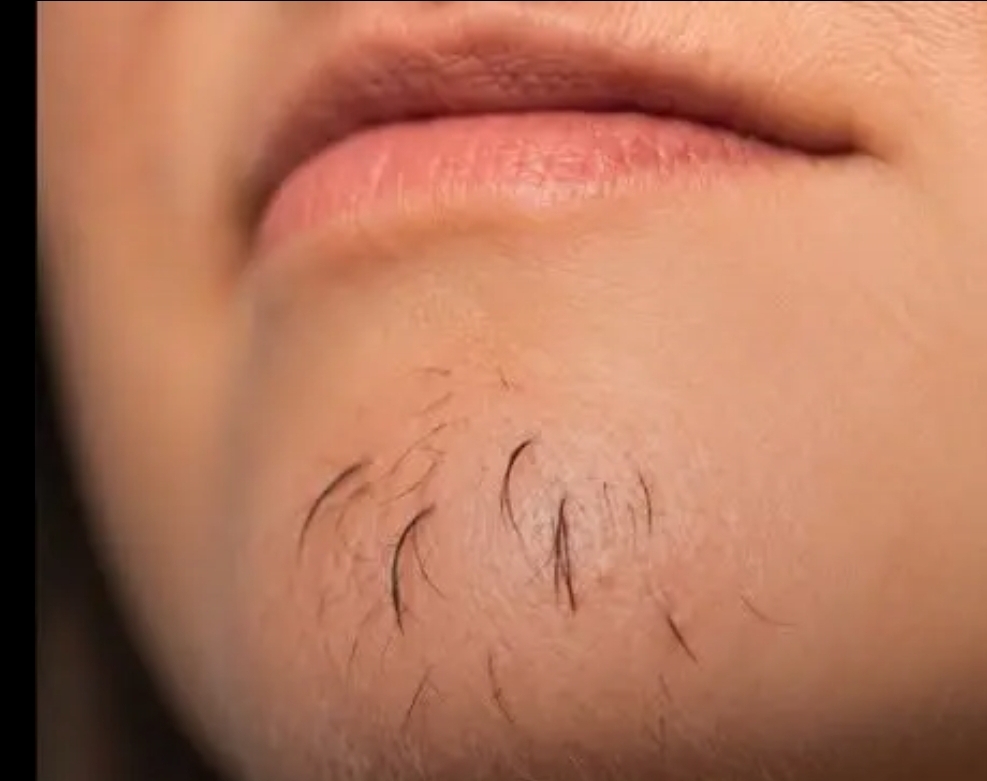
Finding a few dark hairs on the chin is very common, particularly as women get older. A single coarse chin hair does not automatically mean that something is wrong.However, when facial hair becomes noticeably thicker, darker, or more widespread, hormones can sometimes play a role. Understanding the possible causes can help you decide when ordinary grooming is enough and when it may be worth speaking with a healthcare professional.Why Do Women Develop Chin Hair?Hair growth is influenced by androgens, a group of hormones that includes testosterone.Women naturally produce androgens, but their levels and the sensitivity of hair follicles to these hormones can change throughout life.A few coarse hairs on the chin can therefore appear without there being an underlying medical problem.This becomes particularly common with aging because hormonal changes can alter the balance between estrogen and androgen activity.Chin Hair Can Become More Noticeable With AgeAs women enter and move through menopause, estrogen levels decline substantially.This can change the relative effect of androgens on certain hair follicles. As a result, some women notice:More coarse chin hairsDarker facial hairsHair appearing around the upper lipThicker hairs on the jawlineLess hair on the scalpChanges in body-hair distributionHaving a few facial hairs during or after menopause is therefore not unusual.Could Chin Hair Be Related to Hormonal Changes?Sometimes.When excessive coarse facial or body hair develops because of increased androgen activity, doctors may describe it as hirsutism.Hirsutism usually involves coarse, dark hair appearing in areas where women typically have less terminal hair, such as:ChinUpper lipChestAbdomenBackHowever, not every woman with facial hair has abnormal hormone levels.Hair follicles can also be more sensitive to normal androgen levels.Polycystic Ovary Syndrome (PCOS)One recognized cause of excess facial and body hair is polycystic ovary syndrome (PCOS).PCOS can be associated with increased androgen activity and may cause symptoms such as:Excess facial or body hairAcneIrregular menstrual periodsDifficulty becoming pregnantScalp hair thinningWeight-related metabolic problemsPCOS usually develops during the reproductive years, so new facial hair after menopause should not automatically be attributed to PCOS.Other Possible CausesOther Possible CausesHormonal changes are only one possibility.Excess facial hair can also be associated with:Certain medicationsAdrenal disordersOvarian disordersCushing syndromeCongenital adrenal hyperplasiaIncreased androgen productionFamilial or genetic factorsIn many women, however, no serious underlying condition is found.When Is Chin Hair Worth Discussing With a Doctor?A few isolated hairs generally aren’t an emergency.It’s more important to seek medical advice when facial hair appears suddenly or increases rapidly, particularly when other symptoms occur.Contact a healthcare professional if you notice facial hair together with:Rapidly increasing hair growthSevere or new acneSignificant scalp hair lossIrregular or absent menstrual periodsDeepening of the voiceIncreased muscle massIncreased hair growth on the chest or abdomenOther sudden physical changesRapid development of multiple androgen-related symptoms can warrant hormonal evaluation.What Tests Might a Doctor Consider?Depending on your symptoms, medical history, and age, a healthcare professional may consider blood tests to evaluate hormone levels.Possible tests can include measurements of:TestosteroneDHEA-SOther androgen-related hormonesAdditional tests may be appropriate depending on the suspected cause.Testing should be individualized rather than assuming that every woman with one chin hair needs a hormone panel.Does Chin Hair Mean High Testosterone?Not necessarily.This is one of the most common misconceptions.A woman can have facial hair while her hormone levels are within the normal range. Hair follicles can respond differently to hormones, and aging can change the pattern of hair growth.Therefore, the presence of a few chin hairs alone cannot tell you whether your testosterone is high.What About Menopause?Menopause is an especially important time when women may notice changes in facial hair.During menopause, estrogen production decreases. The resulting change in the hormonal balance can make androgen-related hair growth more noticeable.At the same time, women may experience other changes such as:Hot flashesSleep changesVaginal drynessChanges in skin textureScalp hair thinningChanges in body-hair distributionThese changes can be part of the normal menopausal transition.Safe Ways to Remove Chin HairIf the hair is simply a cosmetic concern, several options are available.TweezingTweezers are convenient for removing a small number of individual hairs.Make sure the tweezers are clean, and avoid repeatedly irritating the same area.ShavingFacial shaving does not make hair grow back thicker or darker.It simply cuts the hair at the surface, which can make newly growing hair feel blunt or more noticeable.WaxingWaxing removes hair from the root but can irritate sensitive skin.People with easily irritated skin should be cautious.ThreadingThreading can remove multiple facial hairs and is commonly used for areas such as the upper lip and chin.Laser Hair RemovalLaser treatment can provide longer-lasting reduction in hair growth.Its effectiveness depends on factors including hair color, skin tone, the type of laser used, and the hormonal cause of hair growth.ElectrolysisElectrolysis is another longer-term hair-removal option and can be particularly useful for individual hairs.A qualified professional should perform these procedures.Don’t Blame YourselfFacial hair can sometimes feel embarrassing, especially when social media presents completely smooth skin as the standard.But a few chin hairs are a normal part of aging for many women.They don’t mean that you are unhealthy, unattractive, or doing something wrong.If the hair growth is gradual and limited to a few hairs, simple grooming may be all that’s necessary.The Important Difference: A Few Hairs vs. Sudden Excess HairThis is perhaps the most useful way to think about the issue.A few occasional chin hairs:Often associated with normal genetics, aging, or hormonal changes.Rapidly increasing coarse facial hair:Worth discussing with a healthcare professional, particularly if other hormonal symptoms are present.This distinction is much more useful than assuming that every chin hair indicates a particular disease.Frequently Asked QuestionsIs one chin hair a sign of a hormone problem?Usually, one or a few chin hairs are not enough to indicate a hormone disorder. Facial hair becomes more concerning when it is excessive, rapidly increasing, or accompanied by other symptoms.Why do women get chin hair after 40?Aging and hormonal changes can alter facial-hair growth. Many women notice more coarse facial hairs during and after menopause.Does plucking chin hair make it grow back thicker?No. Plucking removes the hair from the follicle, but it does not change the follicle into a thicker follicle.Does shaving make chin hair thicker?No. Shaving does not increase the thickness or growth rate of the hair. The blunt cut end can simply make new growth feel rougher.Can chin hair be caused by PCOS?Yes. PCOS is one possible cause of excessive facial and body hair, particularly in women who also have symptoms such as irregular periods, acne, or scalp hair thinning.Should women with chin hair have their hormones tested?Not necessarily. Testing is generally more relevant when facial hair is excessive, develops quickly, or occurs alongside other symptoms suggesting an androgen-related condition.Final ThoughtsA few chin hairs are very common and often completely normal, especially as women age and experience hormonal changes around menopause.Chin hair by itself does not prove that testosterone is high or that a woman has a medical condition.The situation deserves more attention when facial hair becomes suddenly or significantly more pronounced, particularly when accompanied by acne, scalp hair loss, menstrual changes, voice changes, or other signs of increased androgen activity.For a few unwanted hairs, simple methods such as tweezing, shaving, threading, or professional hair-removal treatments can be effective. For sudden or extensive hair growth, a healthcare professional can help determine whether hormonal testing or further evaluation is appropriate
What Can Chin Hair in Women Be a Sign Of? Causes, Hormones, and When to Get Checked