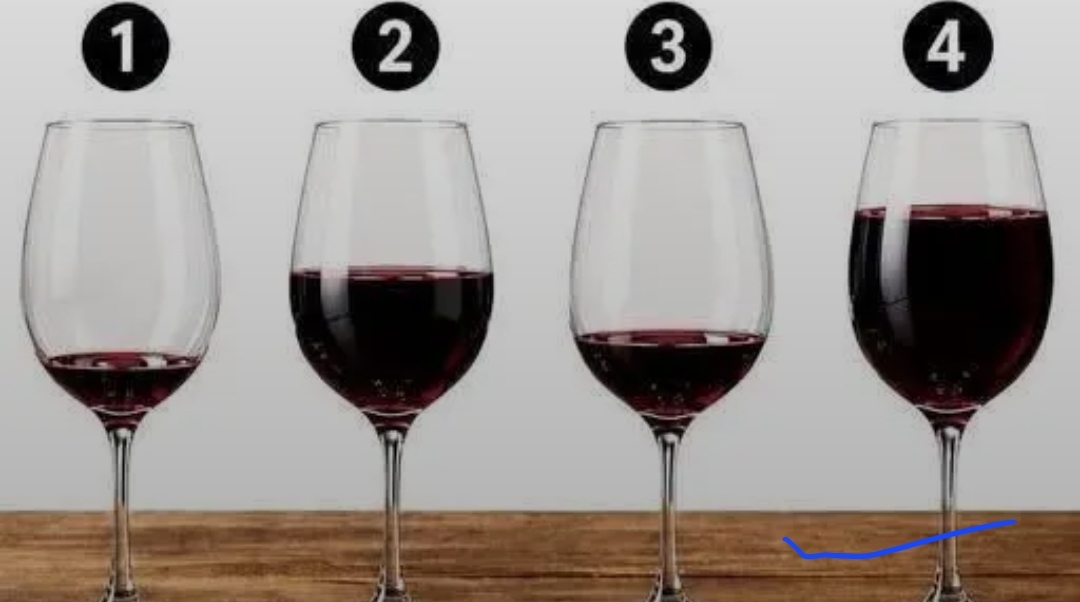
The Great Wine Pouring Mystery: Which Glass Is Filled Correctly?Imagine you’re hosting a cozy dinner party with close friends. The music is soft, the food smells amazing, and you’ve just uncorked a beautiful bottle of red wine.You grab the glasses, raise the bottle, and then… you hesitate.How much wine should you actually pour?It sounds like a simple question, but once you put four different glasses on the table, suddenly everyone has an opinion.That’s exactly what makes this little puzzle so much fun.Four glasses—numbered 1 through 4—hold different amounts of crimson liquid. One is barely filled, another sits somewhere in the middle, another has a somewhat fuller pour, and the last is practically overflowing.At first glance, it feels like a trick question.Is there really a “correct” way to fill a wine glass?Well, yes and no.The answer depends on what we’re measuring:etiquette, wine service, tasting technique, or simply personal preference.So let’s take a friendly, step-by-step look at the mystery and see what the shape of a wine glass can teach us about pouring wine.Meet the Four ContestantsLet’s imagine the four pours from the puzzle.Glass 1: The “Micro-Pour”Glass 1 has barely a splash at the bottom.If you poured this for a dinner guest, they might look at you and wonder whether you’re running out of wine—or whether they’ve accidentally wandered into a very serious professional wine tasting.There’s certainly plenty of room in the bowl.But as a typical dinner-party serving, it’s awfully small.Glass 2: The “Balanced Pour”Glass 2 contains noticeably more wine and looks relatively balanced inside the bowl.This is the kind of pour that immediately feels reasonable.It’s not stingy.It’s not dangerously full.And there’s still room above the glass almost to the rim leaves very little room for swirling or capturing aromas.So Glass 4 is easy to eliminate if the goal is proper wine service.Why Do Wine Glasses Have That Strange Shape?Before deciding which pour works best, it helps to understand why wine glasses look the way they do.Before deciding which pour works best, it helps to understand why wine glasses look the way they do.Unlike a regular water glass, a wine glass usually has a bowl that is wider toward the bottom and narrower toward the top.That shape isn’t merely decorative.The bowl provides space for the wine to interact with air, while the narrower opening helps concentrate aromas near the top of the glass.And that’s where the famous wine-swirl comes in.What Does Swirling Actually Do?When you gently swirl wine in the glass, you increase theamount ofwine exposed to air.That can help release volatile aroma compounds, making the wine’s scent easier to notice.And smell plays a huge role in how we experience flavor.That’s why wine tasting isn’t simply about taking a sip.You might look at the wine, smell it, swirl it, smell it again, and then taste it.Suddenly, that strange-looking glass makes a lot more sense.Why Filling the Glass to the Top Isn’t IdealNow let’s return to our puzzle.Imagine Glass 4 filled almost all the way to the rim.Try giving it a gentle swirl.You probably won’t get very far.There’s simply not enough empty space.The wine can splash over the edge, and instead of releasing aromas gracefully, you’re suddenly reaching for a napkin.A full glass also makes it harder to comfortably bring the bowl toward your nose without getting wine everywhere.That’swhy wine is generally served with some empty space above the liquid.The empty portion isn’t wasted space.It’s part of the design.But Is Glass 1 Too Empty?Now we swing to the other extreme.Glass 1 gives you plenty of room to swirl.In fact, you could probably swirl it like you’re conducting an orchestra.But there’s another consideration: serving size.A tiny splash may make sense in a formal tasting where you’re sampling many different wines. In that setting, the objective is often comparison rather than enjoying a full serving.At a dinner party, however, a tiny splash may feel more like a sample than a normal pour.So Glass 1 isn’t necessarily “wrong” in every circumstance.It’s simply less convincing as the standard dinner-party pour we’re imagining.The Real Debate: Glass 2 vs. Glass 3And now things get interesting.Once we’ve eliminated the obviousextremes, we’re left with the two pours that look much more reasonable.Glass 2 and Glass 3.This is where many people instinctively make their choice based on appearance.Glass 2 may look perfectly balanced because the liquid appears to sit around the middle of the bowl.But here’s the interesting part:The halfway point of a glass isn’t necessarily the ideal amount of wine.Why?Because wine glasses aren’t shaped like straight cylinders.The bowl widens and narrows.That means the same volume of wine can look very different depending on where it sits in the bowl.It’s About More Than the Height of the WineThis is the little detail that makes the puzzle clever.If you simply draw an imaginary horizontal line across the glass and choose the one that looks “half full,” you’re judging the wine based on height.But the volume of liquid dependon the shape ofthe bowl, too.A small increase in height around the widest part of the bowl can represent a noticeably different amount of wine than the same increase near the narrower top.So when you’re trying to decide which glass is “correct,” don’t judge only by how high the wine reaches.Look at the relationship between the wine level and the widest part of the bowl.The Importance of the Bowl’s Widest PointThe widest portion of a wine glass is particularly interesting because it provides a generous area around which wine can interact with air.When wine sits below the rim, there’s also room for aromas to collect in the glass.This is one reason a proper wine pour generally leaves a substantial amount of space above the wine.You want enough wine to enjoy—but you also want enough room to swirl, smell, and sip withoutspilling.That’s the balancingact.So Which Glass Is Correct?Here’s where I would be careful with the word “correct.”There isn’t one universal fill line that applies to every wine glass, every wine, and every drinking situation.Wine service recommendations vary depending on the style of wine, the size and shape of the glass, and whether you’re tasting or simply enjoying a glass with dinner.So if the puzzle expects one particular numbered answer, the actual image and its exact fill levels are necessary to identify that intended answer confidently.From the written descriptions alone, we can confidently say:Glass 4 is excessively full for comfortable swirling and aroma appreciation.Glass 1 is unusually small for a typical dinner serving, though a small tasting pour can be intentional.Glasses 2 and 3 are the meaningful contenders based on the description.The best choice should leave enough room to swirlMy aunt made this for Sunday supper and it completely stole the show. It is unbelievably creamy and the savory meat is perfectly fork tender..Full recipe 👇 💬Different From Dinner ServiceThis distinction helps explain why Glass 1 shouldn’t necessarily be called “wrong.”At a formal tasting, you might receive a relatively small amount of wine.Why?Because you’re expected to examine and compare multiple wines.A tasting pour doesn’t need to resemble the amount you’d drink with a meal.At dinner, the goal is different.You’re probably having one or two wines with food and conversation, so the serving is larger.Neither approach is inherently wrong.They’re simply different situations.A Simple Rule for Pouring Wine at HomeIf you’re hosting dinner and don’t want to overthink it, remember this:Pour enough wine to enjoy comfortably while leaving plenty of room above the liquid.You should be able to gently swirl the wine without worrying that it will leap over the rim.You should also be able to bring the glass toward your nose without immediatelybumping your face into a wall of wine.And, of course, you should be able to carry the glass from the kitchen to the dining table without requiring the concentration of a professional tightrope walker.Common Wine-Pouring MistakesFilling the Glass to the RimThis is probably the easiest mistake to spot.A completely full wine glass might look generous, but it leaves little room for swirling and makes spills much more likely.Assuming Halfway Is Always CorrectThe halfway point can be visually appealing, but the shape of the glass matters.A wine glass isn’t a measuring cylinder.Forgetting About the Glass ShapeA large red-wine glass may hold considerably more liquid than a smaller white-wine glass.The same fill height therefore doesn’t necessarily represent the same volume.Pouring Based on Generosity AloneMore wine isn’t automatically better.A giant pour can make the wine harder to smell,harder to swirl, and harder to drink comfortably.Frequently Asked QuestionsShould you fill a wine glass all the way?Generally, no. Leaving space above the wine allows room for swirling and helps keep aromas concentrated in the bowl.How full should a red wine glass be?There’s no single universal fill line. A moderate pour that leaves plenty of space for swirling is generally more practical than filling the bowl close to the rim.Is half a wine glass the correct amount?Not necessarily. Wine glasses vary considerably in size and shape, so visual halfway doesn’t automatically correspond to an appropriate serving.Why shouldn’t you fill wine glasses to the top?A full glass leaves little room to swirl the wine and increases the chance of spilling. It also reduces the practical space available for aromas to collect above the wine.Is a small wine pour wrong?Notat all. Small pours are common in wine-tasting settings, where people may sample several wines. A small pour may simply be less appropriate for a typical dinner serving.Does swirling really make a difference?Swirling increases the wine’s exposure to air and can help release aromatic compounds, making the wine’s aromas easier to detect.Does the type of wine change the ideal pour?It can. Different wines are served in different glass shapes and may be enjoyed in different quantities. That’s another reason there isn’t one universal fill height for every wine glass.The Fun Part of the PuzzleWhat I love about this little challenge is that it looks like a simple visual question.Which glass is filled correctly?But once you start thinking about it, you’re suddenly considering glass geometry, serving size, aroma, swirling, etiquette, and even the difference between wine tasting and dinner service.And that’s thetrick.The answer isn’t necessarily the glass that looks most balanced.It’s the glass that makes the most sense for how wine is actually meant to be enjoyed.ConclusionSo, which glass wins?If we’re judging the four choices as described, Glass 4 is clearly too full for comfortable wine service, while Glass 1 looks more like a tasting pour than a typical dinner serving.That leaves Glass 2 and Glass 3 as the serious contenders—but without the original image showing their exact fill levels and the shape of the particular glass, it would be misleading to declare one of them definitively correct from the text alone.And that’s actually the most useful lesson from the puzzle.Don’t pour wine based on a simple “half-full” rule.Consider the size and shape of the glass, leave room for swirling, give the aromas somewhere to collect, and choose a serving thatmakes sense for the occasion.Because thebest wine pour isn’t the biggest one.It’s the one that leaves you enough room to enjoy what’s in the glass.And, ideally, enough room to carry it to the table without redecorating the carpet!Keep reading — tap the button below to continue.
Which glass is filled correctly?